Ukraine Invasion 2: We're the baddies now

Ukraine is attempting to address its various manpower issues and is getting a lot of pushback against how they’re going about it.


Background

Ukraine has a lot of problems with force quality which results in recruits (and also some veterans) wanting to go to some units while avoiding others. In November last year a simplified version of returning after going AWOL was introduced which led to 29,000 soldiers returning. There’s a lot of politics involved, but eventually a system emerged where

AWOL increasingly became an informal channel for transferring between units. A soldier typically first applied for an official transfer, only to be denied. They would then go AWOL, secure a written recommendation from the receiving unit, and report back to the military. With that document, instead of returning to their original unit, they were reassigned to the new one, effectively completing the transfer.


This was largely seen as a success, although it leads to some obvious problems, especially that manpower problems for some units get worse and worse.


Syrskyi took over Zaluzhnyi’s role as Commander in Chief. He is originally russian, and he was in charge of Bakhmut, which most soldiers now believe was foolish to hold against Wagner, as it was a meatgrinder which resulted in the death of a lot of experienced veterans for little gain. He has a reputation for micromanaging and not caring about the lives of soldiers, especially since he is a graduate from a russian military academy.

New Regulations

Yesterday this loophole was ended, AWOLs can no longer return with a letter of recommendation and then transfer to that unit. Most people believe that this is a way to force recruits into “Syrskyi’s” assault units which have a higher casualty rate.

After all of the blowback, the General Staff released a message saying:

The changes introduced do not alter the conditions for returning to service after AWOL. At the same time, it should be noted that these changes make it unnecessary for military personnel to go AWOL in the hope of being transferred to their chosen military unit.

[…]

There are other legal ways for transferring between unit, that do not involve AWOL.

To which people are saying that this was a fix for the broken transfer system (which remains broken and now has no loophole), and now people will just desert instead of returning at all.
4 Likes

btw, Thanks for all your updates randomguy!!

9 Likes

cosign, this is great stuff and it’s hard to filter the noise on my own

8 Likes

https://x.com/eucopresident/status/2001833884024213533?s=20

Nielsen is quite upbeat about European funding for Ukraine.

1 Like

I didn’t think europe would not fund Ukraine, I do worry that they chicken out with the russian funds though.

1 Like

Belgium won’t allow them to use the Russian funds without some very difficult to provide guarantees because the funds are not held by the EU they are held by a Belgium clearing house.

1 Like

I’m sympathetic to them, they are being given a task which currently has no mechanism to actually accomplish. But I think this is this saga’s newest instance of trying to get a unanimous decision among 27 nations, and ultimately the problem is that Europe just isn’t taking russia seriously. They’ve known that russia is at war with them for a decade now, and Europe hasn’t prepared adequately.

Ultimately this is going to come down to a situation where they just need to figure it out and do it, but they aren’t prepared for what retaliation for that will be so they are not willing to do it; this is the most recent excuse. They’re likely going to face increased pressure from russia, and now trump, making this more difficult in the future.

I think they’ll eventually do it, but it would be nice if there wasn’t still a possibility that they won’t.

Seems like only half the clip, and the music ruins it a bit, but still a great video to get a feeling for what it’s like in Pokrovsk, and the front line in general:

https://x.com/RALee85/status/2002665430092296319?s=20

6 Likes

Good read on Ukraine’s new defensive lines. Hopefully they are as good as the video looks

https://x.com/clement_molin/status/2003477542557352173?s=20

Thread reader:

https://twitter-thread.com/t/2003477534617338155

1 Like

Help me understand. I thought fortifications stopped being an effective thing circa 1918. What’s the thinking on that changing now?

Watching that I couldn’t help but think of Russians digging tank holes through it while the drones and flamingos rain down. Tough job!

1 Like

Fortifications like this are there to slow down infantry and tanks and that has never stopped being useful. Saddam even had them in the desert probably the least effective environment to have them. Air superiority stopped Saddam from inflicting heavy casualties but the Gulf war with current drones would have cost a LOT more lives in those locations.

1 Like

I don’t think it’s accurate to say that fortifications stopped being effective after WW1. I think there’s a lot of misconceptions regarding the Maginot line if that’s what this refers to.


As Dutch said, this is not what one would normally think about with the word “fortification” (although I think those fortifications are located behind what is shown). The main thing here is that large amounts of land have been cleared, so it’s impossible to sneak up to this area; this is a key component to russia’s current strategy. Infantry has to go through mine fields, they’re easy to spot, and then at some point they have to cut through several layers of barbed wire to advance. Even if they are able to get past that, it’s difficult to move a lot of people through it.

It’s also really effective now to funnel people through certain spots, and then park drones nearby. When a drone operator see someone moving, they activate the drone and go kill them. I’ve been looking for a clip which doesn’t involve a gruesome death to post here, but so far I haven’t found any.

Traditional fortifications have played a key role in the Ukraine war since the start. Avdiivka was a fortified area which held out against russia since 2014. It inflicted enormous casualties until Ukraine started to run out of artillery ammo, and Johnson kept congress from sending them any.

Ukraine’s counteroffensive failed largely due to the Surovikin Line. russia built a huge complex of trenches, anti tank ditches and dragon’s teeth, which stopped Ukraine from advancing. Ukraine had similar problems in Kursk as well: they advanced until they hit fortifications.


Drones have definitely changed this. Fortifications were extremely successful against russia’s armored columns, and that was the main worry at the start of the war. Ukraine began building more of these fortifications around areas close to the border and front line, especially Kharkiv. Due to the way the war has advanced, especially with drones, a lot of them are now pretty much useless. Some of them were built facing a certain direction (where the tanks were going to come from), but obviously a drone isn’t limited in that way and can fly behind these fortifications. Some fortifications were also built at places where they could have a good view of where an attack was expected to come from, but once again this just makes them a target for drones and also glide bombs.

Trench fortifications remain important, but they need to be in a place where they’re not easily visible, which usually means in a tree line.

If you want to take a looser definition for “fortification”, buildings are incredibly important. The video I posted earlier where there’s around 10 drones hitting it show why. In Krynky, the Ukrainian marines were holding out in what is pretty much rubble.

4 Likes

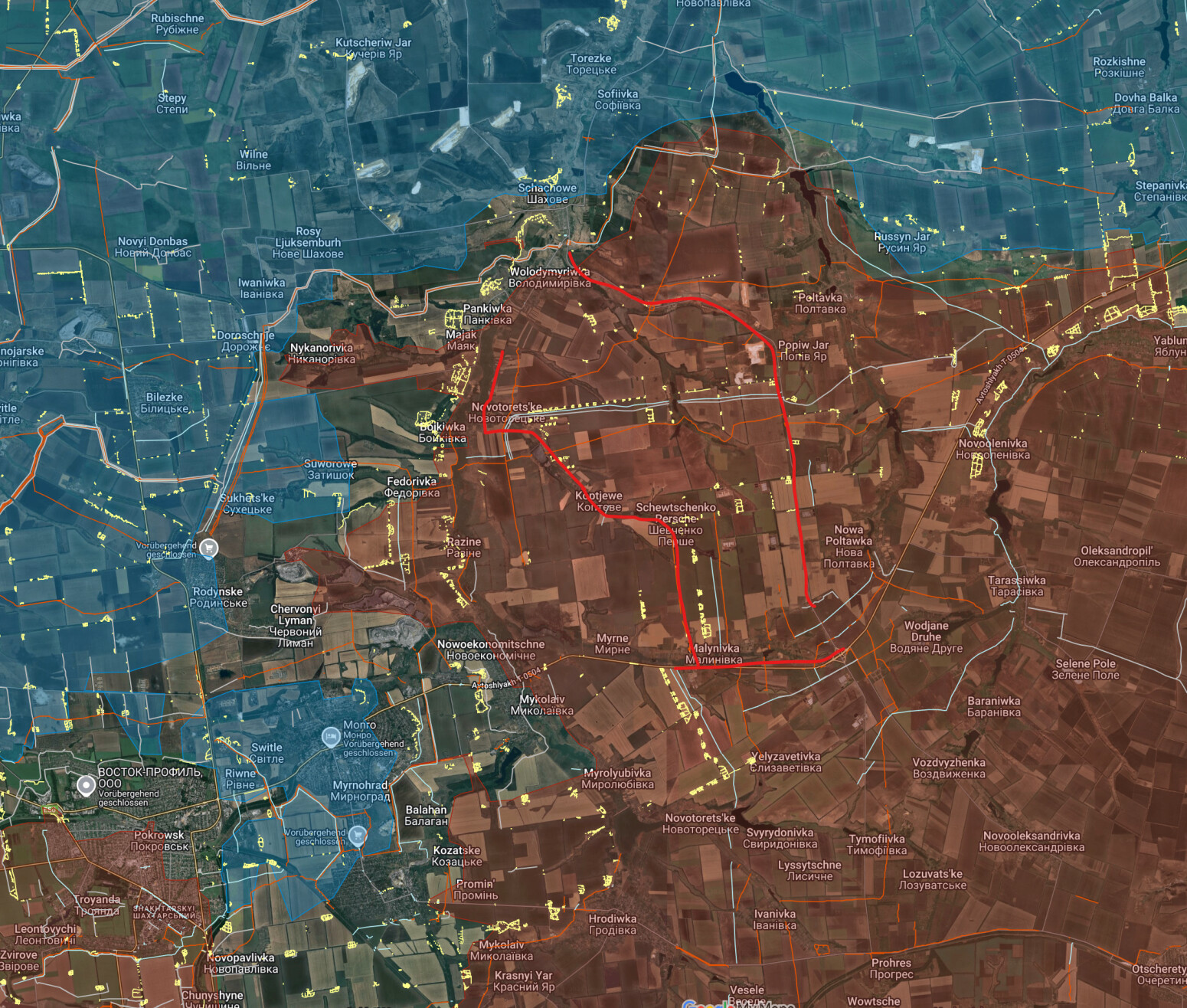
Here’s a good map to illustrate it. Ukraine’s ability to hold this back is probably due to fortifications built prior to the advances here. Due to the anti-tank ditches, rivers, and other natural barriers, vehicles get forced along those two thicker red lines, so there’s a lot of choke points for them to get attacked.

Infantry also hits similar chokepoints and even if they make it through this funneling, they have other fortifications they have to get through in the gray zone.

1 Like

It isn’t that they weren’t effective in WWI that got rid of them, it was the advent of motor vehicles that let them be bypassed more easily. The Ukraine conflict is different because the Russians aren’t massing tanks and trucks and don’t have air superiority so these types of defenses will slow down assaults which probably make it easier for drones to find targets.

2 Likes

This makes sense. I guess that drones have kind of shifted the balance between offence and defence again.

You can put a lot of defensive drones in an area for not very much money in a way that makes a tank attack very expensive.

Yeah, Random’s explanation is better, if you know where the choke points are and can monitor them you suddenly have a few hundreds yards of ground to cover with artillery or drones or air support or whatever, instead of miles and miles of it.

But I don’t think it’s a whatever, because if its artillery and tanks that are defending then you just need more artillery and tanks and planes and you win that battle, break through and then go around, which seemed to happen repeatedly during WW2.

I mean, there were definitely trenches and tank traps, and they weren’t meaningless, but other than a few exceptions which was more about mud, they didn’t lead to armies getting completely bogged down in static lines

1 Like