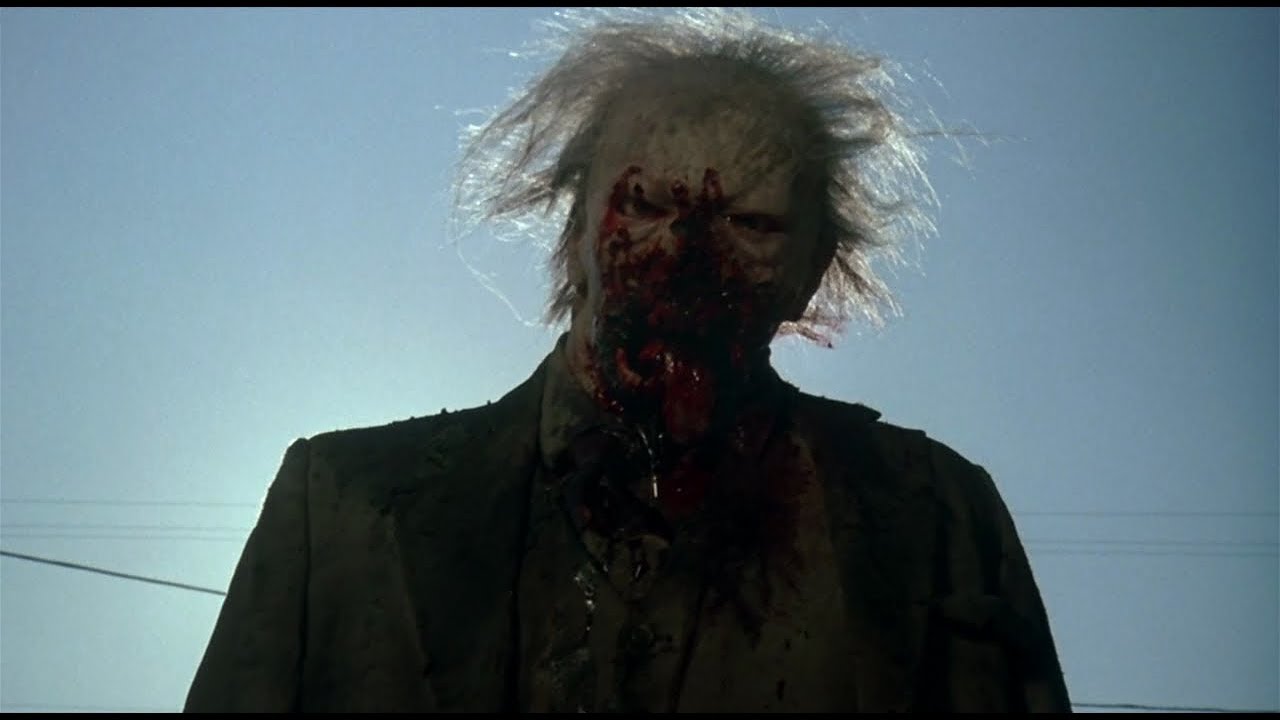
an unemployed south philly dock worker (john cusack) stumbles upon a million dollars in cash destined for donald trump’s casino. lots of fun actors in this one, michael madsen, james galdalfini, benicio del toro, phillip seymour hoffman. it’s money for nothing (1993)
in one scene, he asks a bartender how much it would cost to get everyone in this packed bar drunk. the barteneder says $400. so you gotta remember this million dollars he finds are 1993 dollars, it’s like 50 million dollars today.
interesting exploration into an early 90s view of the hopeless plight of the working class and the end of the american dream. 30 years later, it’s safe to say things didn’t get any better.
Okay, so I said this after watching Fellowship, when they’re repeatedly trying to kneecap the mission to save the world, and they’re doing it through sheer worthlessness. I admit after rewatching The Two Towers (2002) just now that they do spend that whole movie being pretty good characters who are not active liabilities.
Separate from just the Merry/Pippin stuff, I must say: I no longer think that Fellowship vs. Two Towers is a particularly close question. Fellowship, while overall still excellent, has certain sequences that have become a bit of a chore with time. The Two Towers holds up a masterpiece that, if anything, I’ve underestimated in terms of just how high up the all-time greatest films list it should be.
One of the least interesting popular concepts is that of the long-form battlefield sequence. Large groups of people firing weapons at each other is an utterly boring enterprise in the overwhelming majority of circumstances, and when I encounter such sequences I frequently find myself just wishing they could just fast-forward to the end and tell me the result. To my mind, there are basically two major exceptions: (1) the early extended battlefield sequence in Saving Private Ryan; and (2) the Battle of Helm’s Deep in this one. The Battle of Helm’s Deep is an incredible cinematic achievement, not just in a vacuum but in its transcendence of the usual battlefield fare.
I’d never seen any of these and was interested in the new one so decided to watch this. It’s good. Not really my thing though. It’s the single worst looking major release film I have ever seen. It’s genuinely ugly and actually hard to watch. It affected my enjoyment quite a bit.
I am going to try the second one to see if maybe with cinematography that doesn’t make me want to crawl out of skin I might like it more.
Hell yes. I think that for North American viewers in 2025, the cultural context of his movies will be lost on us, whereas with Past Lives the cultural context is very clear to me (I know plenty of immigrants in Toronto and married into an immigrant family, the dynamics are very familar to me - lucky for me no handsome stranger from my wife’s past has showed up yet!).
Wong Kar Wai is great though. In The Mood For Love is my favorite of his movies.
I watched the original Scream last night. Since I’ve seen it several times, I started paying more attention to how it looked. As far as I can remember, it has a pretty typical look for a 90s movie, and it didn’t have a big budget ($14 million). But it looks a lot better than the median film today.
I’m guessing there are several reasons:
Shot on film
No noticeable (to me) color grading/correction
Shot on real sets and locations instead of green screen/volume technology
Veteran cinematographer (he did The Fly and other Croneburg movies)
Would love to hear from someone who knows more about the technical and economic aspects of filmmaking if there are other reasons so many movies today look like shit, and why studios do it this way (I’m guessing because of cost).
Mainly blame teal and orange. It took over movies in the 2000s. It’s an unrealistic and ugly look that is all over blockbusters.
Not shooting on film is not an excuse, as there are a lot of ways to make video effectively look like film and this has been the case at least since 2007.
Michael Mann’s cinematographer got in a heated argument with Chris Nolan in a Heat panel about film vs. video. Mann’s guy won the argument and yet Nolan still refuses to shoot on video as far as I know. If you’re unaware, almost nobody shoots on film anymore and yet tons of movies look just as good as any filmed movie today and it’s a lot easier to do.
I’ve seen 28 Days Later multiple times (20 years ago) but I don’t remember the look of it being controversial at the time, guess I’ll have to give it another watch.
Haven’t seen the second one, but: worth noting that the new one looks great IMO. They didn’t just keep with the rough aesthetic from the first installment.
I still think the first movie is definitely better overall, but liked this one.
I did know that almost everything is shot on video now. But one thing I wonder is whether modern video cameras are so much easier to get a passable image with compared to film that a lot of people have lost the craft (or just don’t want to put in the effort) that it takes to get a great image, whether on film or video.
So I when I say Scream was shot on film, I’m referring both to the physical medium but also using that as a shorthand for traditional movie-making techniques.
Yes and no on the modern video cameras. You can get away with a lot more on modern video cameras, as many can compensate for poor lighting. You still need to have a good skill set to make anything look passable, as it’s rare that the types of cameras used today are plug and play for lack of a better description. I personally have a Blackmagic Pocket Cinema 4K camera, which uses Micro Four Thirds lenses. If I were shooting outside with no lights, I could get a very good cinematic image from it fairly easily. Indoors, it’s very difficult to get shots to look the way I want (I am low skill) even with fairly good lighting that’s not up to anywhere near professional standards. For the best shot at making something that will work pretty easily, you just gotta shoot during the day outside lol.
I think in that part of the industry a lot of knowledge is still being passed down, because very few camerapeople work without assistants. In my part of the field (Re-Recording Mixer), I doubt much knowledge is being passed down at all. Assistants kind of stopped being a thing in the late 90s except at the biggest places, so a lot of people in the industry are just winging it in my profession. I was in the last wave of getting to have something resembling mentors in the mid-90s, but almost all the people I’ve mentored since were higher than assistants and just trying to become better mixers.
I think for your example, it’s that during that era there was a minimum standard everyone could get to due to how good the cameras and lenses were. Regardless of budget (outside of films that could only shoot 16mm), the camera packages were probably very similar for low budget and high budget movies. The difference was that large budget movies could shoot a lot more film and the low budget movies had to be really sharp with how much film they used. These days, camera packages and lenses are all over the map but you can shoot as much footage as you want because the cards to capture the footage are extremely cheap. That may or may not be a double edged sword.
I also think a lot of people used to cut their teeth in the low budget world, often in different crafts than directing. Roger Corman was pretty famous for providing a funnel from B movies to A movies. He taught people how to work on shoestring budgets so they’d be prepared for anything. Those are skills that aren’t often happening these days. I’ve done work for a ton of low budget movies, but I can’t tell you at all how efficient the directors were on set. Some of the movies are decent, most are rarely up to the standard of ok, with a few being atrocious.
Regardless, it’s really up to the eye as to how it turns out. A lot of low budget directors are working with people they worked with in college. Some are very talented, and some aren’t. The difference in making a good looking movie vs. one that isn’t is often up to who is chosen to sit behind the camera. Get that right and your movie is generally off to a good start, unless the director’s vision sucks and is filled with dreams of teal and orange.
going at 930pm tonight. i suspect i’ll enjoy it more than you, 28 days/weeks are top of the food chain zombie movies and i have the cover of the ‘zombie survival guide’ tattooed to my leg lol.