This first direct assessment of 5-HT release capacity in people with depression provides clear evidence for dysfunctional serotonergic neurotransmission in depression by demonstrating a reduced 5-HT release capacity in patients undergoing a major depressive episode.
Suicidal students at Yale are pressured to request “medical withdrawals” from school while still in the emergency room. They often are given just a couple of hours to vacate campus and are then forced to jump through hoops to be reinstated.
Damn. The backwards University of Alabama let me stay in my dorm for months after initiating medical withdrawal, all while going to one of their therapists twice a week. And then let me back in later with zero red tape, like I think I just went online a year later to register and pick a dorm situation, zero red tape, just ticking a box no questions asked
Does anybody have any good reccomends for introduction to Buddhism?
I had a very painful realization about myself last night about how I treat others and Ive found in the past that meditation is a good way for me to examine my thoughts and actions, but I reslly need to take it further than just seeing and acknowledging.
Change isnt an option, its a requirement and I know Buddhism focuses a lot on both acceptance and change, but I dont want to just start anywhere.
Im going to my local temple for meditative practice this weekend and will obviously ask there, but if anyone has suggestions I am all ears.
I would recommend finding a teacher you like. Meditation is based on actual experience, not knowledge, so I don’t think you can really just read books or listen to recordings. The place I go was established and is led by someone who was a student of the late Namgyal Rinpoche, a Canadian lama who was born Leslie Dawson in Toronto. Namgyal taught a number of students in Canada and established some institutions, notably the Dharma Centre of Canada.
Although many of Namgyal’s students (including the founder where I go) went on to be ordained as Tibetan Buddhist lamas or ordained in other traditions, they tend to teach in non-sectarian fashion and present the ideas of Buddhism in a Western context. It’s a middle way between overtly religious Buddhism and the sterile “mindfulness meditation” which you get a lot of these days. Mindfulness tends to be overemphasised in the West because it is the most amenable to scientific study.
Obviously I can’t guarantee that any of the teachers there will be good and I have no idea if you’re anywhere near Ontario, but it’s the best advice I can give. You can contact them and say you want to learn and hopefully they can point you in a good direction.
Previously. It had been the down episodes that I worried about. As I’ve been getting worse this year (Or maybe as my self awareness increases) I’ve started to realise the up episodes can be pretty bad, especially as to consequences.
On my coping tactics list for being up. Among other things. I have “dont send the email”
I’ve sent 3 emails I probably should have thought about first in the last few days.
One last night on work stuff. I sent a long email full of data and bold suggestions and ideas to my entire peer team, plus my bosses boss. Within 10 minutes I had my boss and a peer basically tell me it was inappropriate. Which has kicked off a whole thing of self criticism and feeling fucking awful. Like. Got 3 hours sleep.
The worst thing is not being able to trust my own judgement. Like. Theres a possibility that the email is fine. That I’m creating an appropriate amount of challenge and tension on some issues that need raising and the others are overly cautious and political. t’s also a possibility that I’m off the rails.
Anyway. Had a realisiation this morning that helped.
This cycle of impulsive decision followed by consequence and self recrimination is a classic symptom of bipolar. I need to treat this like my down episodes. Something to endure and overcome with grit and doing the work.
This means following my plan about sleeping, breathing, exercising, being kind to myself, reaching out for help, etc. This thinking has helped.
One concern is that being depressed is much more socially acceptable than being manic. I’ve told work colleagues I get depressed. Theres no fucking way i could say “yeah. Sorry for those emails. Having a hypomanic episode. My bad. Let’s revisit the idea in a couple of weeks”
I dont have a lot of trust for my boss or some of my peers. Both generally and in regards to their willingness and competence to manage mental health challenges sympathetically and without judgement
I could possibly tell a couple of trusted peers. I might do that.
Starting seeing a psych earlier in the year after things got a bit worse. It helped, but i stopped seeing her because she was bad at her job and the marginal value was going way down.
I will find another psych. But prefer managing via behaviour rather than medication.
+1 on preferring managing via behaviour rather than medication. Just speaking from my experience and I’m sure medication has worked for a lot of people here but I found that lithium served as an extremely strong band-aid but it never addressed the reasons for why I felt the way I did. Side-effects also obviously severe (and lingered for years after I tapered off).
I think the next gen of stuff is a little better. But yeah.
It’s not something im ruling out. But will need to keep balancing consequences and impacts of my ups and down vs the risks of side effects etc.
I’ve got a lot better at managing the downs this year. Pretty proud of how I got through a tough patch a couple of months ago. But based on current stretch, need to get better at managing the ups.
I don’t know if medication is the right treatment for you, but a good therapist will help you explore all kinds of options. The big thing treatment beyond self-managed care can do is contribute something that isn’t within your power.
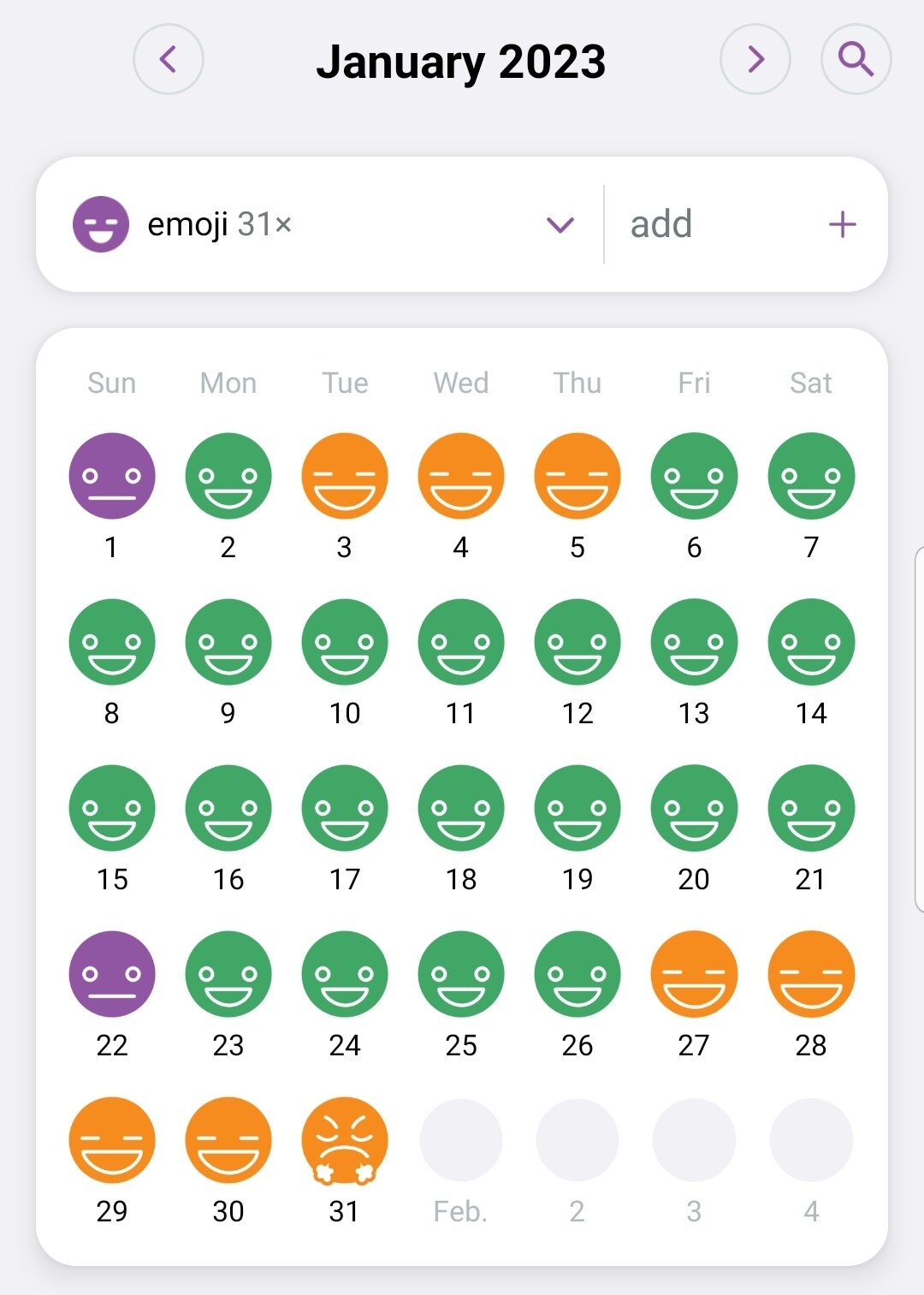
Mood tracking for Jan. Green is good. Purple is a little down. Orange is some version of elevated.
One of the longest periods of stability in a long time. Felt great. Calm. Focused. Productive. Working out. Getting stuff done at work.
Last few days, definitely tripping over into an up phase. Will be managing it closely. Especially at work.
Btw. Update from above. It all worked out with minimal impact. It also prompted me to share my mental health with one colleague which was good. I’ve now got a sounding board.
As someone diagnosed with ADHD, I have mixed feelings about this thread. Yes I was a terrible procrastinator in school, and I always got in trouble for putting off chores. But I also don’t think that I should have been told it wasn’t my fault and that I just wasn’t neurotypical or whatever.
What I really needed imo was good study habits starting in high school. I was a latch key kid and my mom never really had time to help with that stuff. So I just screwed around in high school and got by. By the time I got to college it was too late. I think if I’d had more structure before college, my brain might have wired itself differently so I’d be prepared for college.
There’s tons of stuff we don’t want to do in life. But you do them a few times and they start to become a habit and get easier.
But also it could be I have mild ADHD compared to some people. I feel I could have overcome it. Maybe some cases are much more debilitating.
I did not have at all the same reading of that thread. To me, that would be like hearing the pitch for a twelve step group and saying that an alcoholic recognizing they have a disease is the same as saying they don’t need to take responsibility for anything related to it.
I relate a lot to what the thread says but for other reasons. I am neurodivergent and disabled. People telling me as a kid that I just needed better study habits was part of what traumatized me. As the person writing the thread notes, those unfair expectations and demands on neurodivergent people remains part of what traumatizes us still today.
Or to go back to the alcoholic analogy, some people can just stop drinking and their life straightens out. Other people are actually addicts whose compulsive behavior is the symptom of the problem, but not the problem itself. Corrective behavior just leads to different manifestations of the same problem.