LOL at the range of motion on that set.
5 Likes
I’m not a lifter but that looks like less than full extension. Is that how you’re supposed to do it?
No, it is not.
5 Likes
Yeah it’s not as bad as doing just the top half of the ROM and stopping a foot above his chest (which I see all the time in the gym), but it’s bad. Wanna superimpose that snarky counter someone added to that crossfit kipping pullup gif, where it just keeps flashing zero.
3 Likes
My bench press is pathetic but what in the hell is he doing? Just bouncing that shit off his chest while he’s only balancing on his heels.
1 Like
Weightlifters lol
*lol weightliftaments
C’mon bro, remember our roots.
5 Likes
I didn’t participate in that
do you even incline dumbbell press
Hegseth not getting enough milk obviously. Somebody gotta tell him about Gallon of Egg Nog a Day
5 Likes
Master race of skinny-fat pussies.

*Trumphal Arch
1 Like
oh snap, bringing in the gilders guild?
2 Likes
a crack team of gilders assembled for one last score
1 Like
44 is a lot, this is gonna make me go try this weekend. i think i’ve done like 32-33 before, but that was a while ago and im curious.
(post deleted by author)
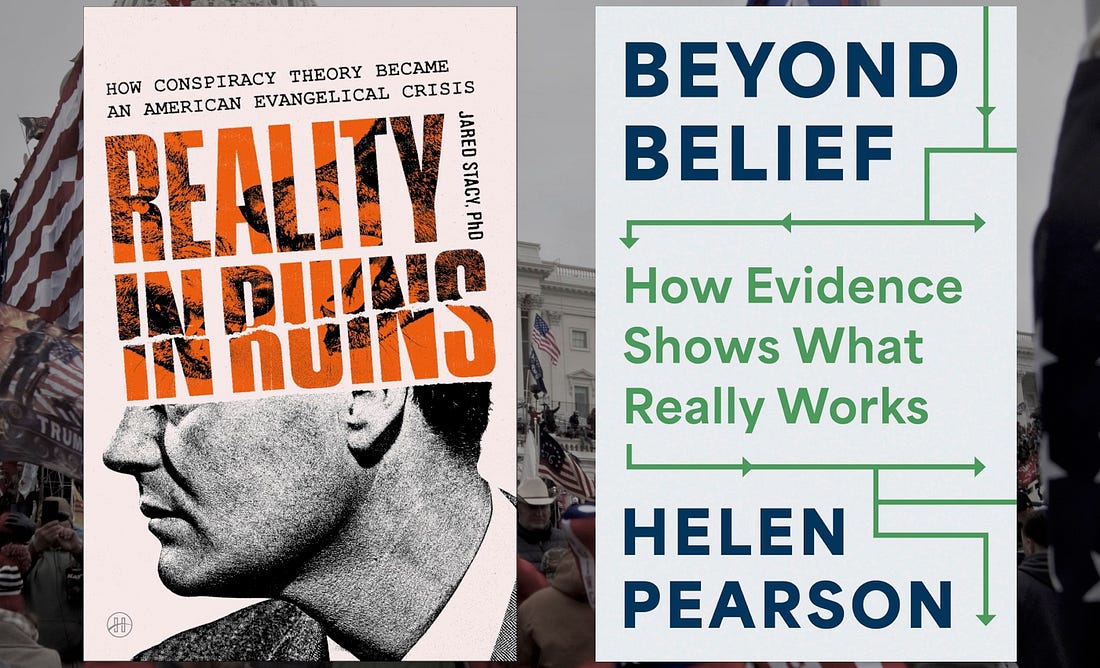
A new book that discusses why Evangelical Christians continue to believe in the nonsense Trump spews, including his claims about the 2020 election.
| tl/dr: They’ve already been trained to substitute belief for reason with respect to their religious views, so it’s not difficult to get them to focus on their feels rather than objective reality when it comes to politics. |
|---|
 |
|---|
(HarperOne; Princeton University Press; background photo of the Jan. 6 Capitol riot by Tyler Merbler)
As the midterms approach, the MAGA sect is reaffirming its core delusions with extra fervency. Chief among those beliefs is widespread election fraud — a spectral phenomenon that feels more convincing the less evidence there is.
Asked to support his claim that California’s vote-counting process “stinks to high heaven,” Speaker of the House Mike Johnson said, “Look, some of these efforts are so diabolical and so far upstream that it’s impossible to prove, but I think everybody knows instinctively something is wrong here.”
In other words, election fraud “is the substance of things hoped for, the evidence of things not seen.”
An illuminating new book called Reality in Ruins has helped me understand the tragic affinity between political paranoia and a certain strain of conservative Christianity.
The author, Jared Stacy, is a former pastor who sets out to show that “conspiracy theory isn’t a bug, but a feature of evangelical Christianity in America.” Still very much a believer, Stacy looks back — from the Salem witchcraft trials to the Jan. 6 riot — to examine how the rhetoric of spiritual peril has been subverted to serve purely political goals.
Stacy notes that conservative Christian groups mobilized aggressively to promote the claim that Biden had stolen the 2020 election. They “propped up the lie by using overtly theological language, often blaming the ‘demonic Democrats’ and issuing calls to prayer when Trump refused to concede.”
“The plausibility rested not in the facts of the case, but in their association with the authority reflected in the Christian story. Taken this way, it didn’t matter whether Democrats actually stole an election. What mattered, and what any ‘biblical’ Christian knows, is the Democrats are the kind of people who would steal an election… The theological and moral plausibility of the Big Lie justified the violence to come.”
Most provocatively, Stacy argues that when the central miracle of Christian faith — Jesus’ resurrection — is miscast as “the prime alternative fact,” it can then be exploited “to authorize other transgressive claims or minority reports on things like vaccines, climate change, or the age of the Earth.”
Jesus loves me, this I know,
Mail-in voting’s got to go.
Now, Stacy warns, many evangelicals are trapped in the “totality of holy paranoia,” where faith in the rightness of Jan. 6 is used “to sanction a myth that will fuel unrestrained seizures of power and tactics of terror.”
As a Christian myself, I appreciate that Stacy isn’t out to prove how crazy evangelicals are. On the contrary, he’s determined to challenge the pernicious element of political conspiracism within the church and reaffirm the essential values of Christian faith that make such violent certainty illegitimate.
Helen Pearson approaches the problem of evidence from an entirely different direction in her new book, Beyond Belief: How Evidence Shows What Really Works. She begins with the startling claim that “the term evidence-based medicine is barely 35 years old.”
From there, she goes on to chronicle “an evidence revolution” driven by people who are transforming business, education, social policy, and policing.
Somehow, I thought this revolution was won during the Enlightenment, but Pearson says all kinds of modern-day fields have rested on conventional wisdom, precedent, and, as Mike Johnson calls it, what “everybody knows instinctively.”
What’s particularly alarming is that we’re drifting back into those medieval vapors.
The Covid-19 pandemic and the extraordinary rush of research it generated also inspired a backlash of misinformation and skepticism about evidence. Given Trump’s systematic attacks on science — and his appointment of a kook as secretary of Health and Human Services — the way forward is not clear.
“Right now,” Pearson writes, “the world needs more people who value evidence, because those who don’t are gaining strength.”
She concludes her book with a list of simple ways to “join the evidence revolution.” For instance, “be skeptical and ask for evidence,” but don’t be a fool. “Many decisions don’t need an extensive review of the evidence… Wear a parachute when jumping from a plane.”
The most profound advice she has is also the easiest: “Citizens of democratic countries have a voice at the voting box, where they can support politicians who stand up for evidence.”
The results of that experiment will become clearer in November.◆